- What the Words Actually Mean
- Why 13 for Boys and 12 for Girls?
- What Actually Changes at Bar or Bat Mitzvah?
- The Bar Mitzvah Ceremony Is Younger Than Most People Think
- Do All Movements Use the Same Ages?
- Why the Hebrew Birthday Does What the Civil Birthday Cannot
- Which Torah Portion Goes With the Date?
- Frequently Asked Questions
- The Bottom Line
What the Words Actually Mean
Quick answer: The traditional bar mitzvah age is 13 for boys, while girls reach bat mitzvah status at age 12. These ages originate in the Talmud and reflect the age of legal responsibility in Jewish law, arriving automatically on the child’s Hebrew birthday. While Orthodox and Conservative communities keep 13 for boys and 12 for girls, many Reform congregations celebrate both at age 13.
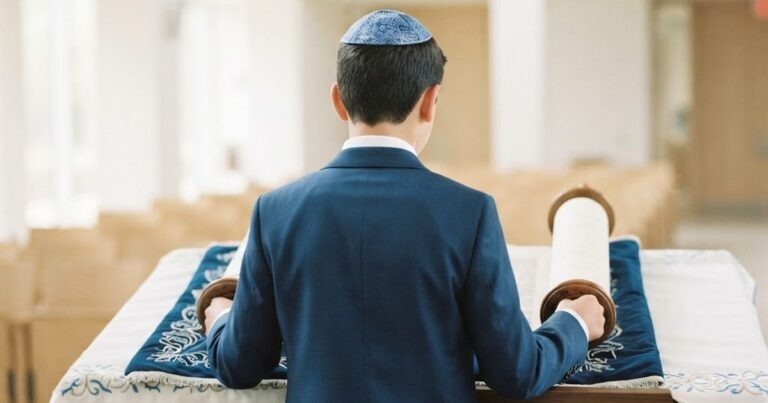
Bar mitzvah is not a party and not a ceremony. It is a status. The phrase literally means son of the commandment, and bat mitzvah means daughter of the commandment. When Jewish tradition says a boy becomes bar mitzvah, it means he becomes a person who is obligated in the commandments, old enough to be responsible for his own Jewish practice. The milestone is not granted by a rabbi, a synagogue, or a celebration. It arrives automatically on the Hebrew birthday, whether or not anyone marks the occasion.
Why 13 for Boys and 12 for Girls?
The ages come from the Talmud, which sets the age of majority for girls at 12 and for boys at 13. The usual explanation is that these ages roughly track physical maturity, and that the rabbis paired the legal change with the biological one. In halachic terms, maturity involves both age and physical development, though for most everyday purposes the birthday alone is what matters.
Why girls a year earlier? The Talmud’s reasoning ties the gap to the different ages at which boys and girls typically begin to mature. From the halachic point of view, that single year is the whole answer. From a historical point of view, it is worth knowing that the age gap had no practical effect for most of Jewish history, because until the modern era there simply was no bat mitzvah ceremony at all.
What Actually Changes at Bar or Bat Mitzvah?
In traditional practice, quite a lot. From the Hebrew birthday onward:
- A boy counts toward the minyan, the quorum of ten needed for communal prayer.
- He becomes obligated in time bound commandments such as hearing the shofar, fasting on Yom Kippur, and wearing tefillin.
- He can be called up to the Torah and can lead services.
- He is responsible for his own actions in Jewish law rather than his parents answering for him.
For girls, the classic framework treats the 12th Hebrew birthday as the age of obligation in the commandments that apply to women. In practice, what a bat mitzvah means religiously varies enormously between communities, which leads to the next point.
The Bar Mitzvah Ceremony Is Younger Than Most People Think
Being called up to the Torah at 13 has medieval roots, but the over the top modern bar mitzvah celebration is a much newer invention. And the bat mitzvah is newer still. The first bat mitzvah in the United States took place in 1922, when Judith Kaplan, the daughter of Rabbi Mordecai Kaplan, recited the blessing and read a passage of the weekly Torah portion at her congregation in New York City. That single event quietly opened a door that Jewish life has been walking through ever since.
Today the ceremony itself ranges from a girl reading from the Torah in an egalitarian congregation to a festive kiddush in an Orthodox community where the public Torah reading is not part of women’s observance. None of these make her a bat mitzvah. The status came automatically at her 12th Hebrew birthday. The event only celebrates it.
Do All Movements Use the Same Ages?
Traditional communities keep 13 for boys and 12 for girls. Many Reform congregations celebrate both boys and girls at 13, so that siblings in the same family mark the milestone at the same age. Some communities use the term b’nai mitzvah as a plural or gender neutral form when talking about a class of students celebrating together.
If your family is part of a specific community, its practice is the one that applies to you, and a rabbi is the right person to ask about local custom. What does not vary is the underlying math: the milestone lands on the Hebrew birthday, which is where most of the interesting questions begin.
Why the Hebrew Birthday Does What the Civil Birthday Cannot
Here is the part that trips up families every year. The bar mitzvah date is determined by the Hebrew calendar, not the civil one, so the 13th Hebrew birthday does not land on the 13th civil birthday. It can fall weeks earlier or later. Celebration is commonly held on the first Shabbat after the Hebrew birthday.
Two rules do most of the work. First, Hebrew days begin at sunset, so a boy born after sunset has his bar mitzvah date shifted by one day relative to his civil birth certificate. Second, the Hebrew calendar adds a leap month seven years out of every nineteen. In leap years, a person born in Adar marks the birthday in Adar II by common custom, though some communities observe Adar I; presenting both respectfully is proper since family traditions vary. There is no need to work this out by hand: our Bar and Bat Mitzvah calculator takes the birth date and returns the exact Hebrew date, the Torah portion for that week, and the nearest Shabbat readings for planning the celebration. The Bar and Bat Mitzvah guide walks through how those dates are calculated and how the milestone Shabbat is chosen.
Which Torah Portion Goes With the Date?
Families often assume the bar mitzvah boy reads the same portion every year, but the weekly reading shifts with the Hebrew calendar. There are about 54 weekly Torah portions in the annual reading cycle; in non-leap years some portions combine, while on holidays a special holiday reading replaces the regular weekly portion. There is also a genuine difference between Israel and the Diaspora: on certain festival weeks, synagogues in Israel and abroad fall out of sync for a week and read different portions. Our guide covers the Israel and Diaspora difference in detail.
To find the Hebrew birthday first, the Jewish birthday calculator and the Hebrew date converter handle the sunset rule, the leap years, and the Adar questions in seconds. Mazal tov on the milestone, whenever it lands.
Frequently Asked Questions
What is the traditional bar mitzvah age?
The traditional bar mitzvah age is 13 for boys, while girls reach bat mitzvah at age 12.
Does a child become bar mitzvah automatically on their Hebrew birthday?
Yes, bar mitzvah is a status of religious responsibility that arrives automatically on the Hebrew birthday whether or not a party takes place.
Why is bat mitzvah celebrated at age 12 instead of 13?
Talmudic tradition sets the age of majority for girls at 12 based on earlier physical and emotional maturity.
Is the bar mitzvah date based on the civil or Hebrew calendar?
The date is determined by the Hebrew birthday, which shifts relative to the civil calendar each year and accounts for sunset birth times.
The Bottom Line
Reaching bar or bat mitzvah age marks an essential milestone of personal responsibility and connection to the Jewish tradition. Calculating the exact Hebrew birthday ensures families can plan ceremonies and weekly Torah readings accurately.
Find your child’s exact Hebrew birthday and weekly Torah portion with our free Bar and Bat Mitzvah calculator.