How Hebrew Letters Represent Numbers
Quick answer: When reading hebrew dates on gravestones, Hebrew letters represent numeric values rather than Arabic numerals. The inscription lists the day of the month first, followed by the Hebrew month name, and then the year without the thousands digit. Because Hebrew days begin at sunset, converting a gravestone date to the civil calendar requires accounting for the sunset boundary.
Hebrew has no separate numerals in the classical system. Instead, each letter carries a numeric value, and numbers are built by adding letters together. The first ten letters cover 1 through 10, then the next nine cover 20 through 100, and the final four cover 200, 300, and 400.
| Letter | Value | Letter | Value | Letter | Value |
|---|---|---|---|---|---|
| Alef | 1 | Yod | 10 | Kuf | 100 |
| Bet | 2 | Kaf | 20 | Resh | 200 |
| Gimel | 3 | Lamed | 30 | Shin | 300 |
| Dalet | 4 | Mem | 40 | Tav | 400 |
| Hei | 5 | Nun | 50 | Final Kaf | 20 |
| Vav | 6 | Samech | 60 | Final Mem | 40 |
| Zayin | 7 | Ayin | 70 | Final Nun | 50 |
| Chet | 8 | Pei | 80 | Final Pei | 80 |
| Tet | 9 | Tzadi | 90 | Final Tzadi | 90 |
The final letter forms, the ones written differently at the end of a word, carry the same values as their ordinary counterparts. A 15 and 16 follow a special rule: they are written as 9 plus 6 and 9 plus 7 rather than 10 plus 5 and 10 plus 6, out of respect for the letter combinations that spell divine names.
How a Date Is Written on a Stone
A typical line reads something like: died on the day of tet vav, in the month Av, in the year tav resh tzadi. In civil terms that is 15 Av 5690. A few conventions make it easier to spot the pieces:
- A quote like mark inside the number, called a gershayim, usually sits before the last letter. It signals that the letters are functioning as a number.
- The year is normally written without the thousands. A stone from the late 1800s or early 1900s usually starts with tav resh, which stands for the 5600s, while a stone from after 1939 usually starts with tav shin, which stands for the 5700s. The year 5690 is written tav resh tzadi.
- The day of the month comes first, then the month name, then the year.
- Some stones spell the month fully, others abbreviate it to a letter or two.
You will also see standard abbreviations that are not part of the date. Pey nun at the top means here is buried. Tzadi nun bet hei, usually at the end, asks that the soul be bound up in the bond of life. Zayin lamed after a name means of blessed memory.
Turning the Hebrew Date Into a Civil One
Once you have the number, you need it in a calendar you can use. Two things matter when converting:
First, the day begins at sunset. If the stone says a person died on 15 Av, the death could have happened any time from the evening that started 15 Av through the following sunset, meaning the civil date could be one of two days depending on whether it was before or after dark. That is why converted dates often come with a note like born in the evening.
Second, Hebrew months do not map to fixed civil dates. Months are lunisolar, lasting either 29 or 30 days in sequence: Tishrei, Cheshvan, Kislev, Tevet, Shevat, Adar (Adar I and II in leap years), Nisan, Iyyar, Sivan, Tammuz, Av, and Elul. Nisan is the biblical first month, while Tishrei begins the numbered year at Rosh Hashanah. A regular year has 12 months (about 354 days), while a leap year has 13 months (about 384 days). They drift against the Gregorian calendar by about 11 days a year until a leap month corrects the drift, making hand conversion error prone.
This is exactly the job our Hebrew date converter was built for. Enter the day, month, and year from the stone and it returns the matching civil date with the sunset boundary spelled out.
Three Traps That Catch Beginners
Missing months. Cheshvan and Kislev can each be 29 or 30 days long depending on the year. If a stone says 30 Cheshvan, you are looking at a year in which Cheshvan was full, and that detail helps verify the year.
Adar in leap years. In a Hebrew leap year there are two Adars. Older stones sometimes just say Adar without specifying which one, so you need to know whether that year was a leap year before converting. Our calendar guide explains the 19 year cycle that governs this.
Transliteration surprises. European stones may spell months differently than modern Hebrew, and very old stones use variant letter forms. Photograph the whole line rather than trusting a first reading.
Why the Hebrew Date on the Stone Matters
The Hebrew date is not decoration. It tells you the yahrzeit, the anniversary on which the family would have lit a memorial candle and said Kaddish each year. If you are continuing that tradition, take the date from the stone, let the converter turn it into civil terms, and then use our yahrzeit calculator to find the anniversary dates going forward. The yahrzeit guide explains the sunset rules and the leap year questions that come up along the way.
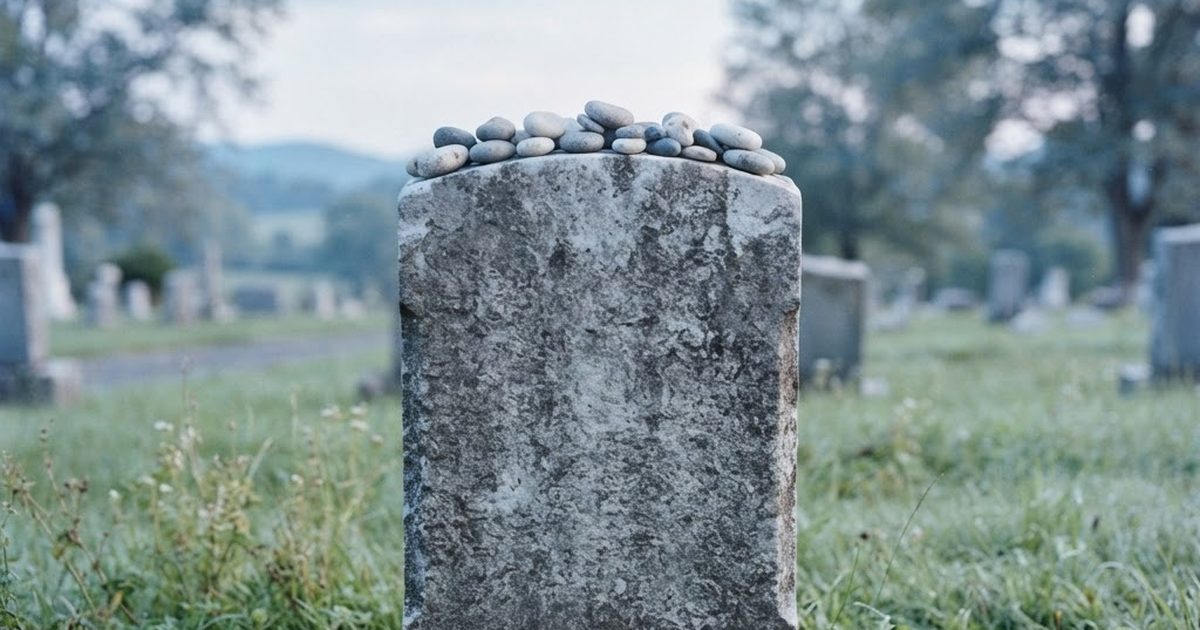
Visiting a grave also carries traditional Jewish cemetery customs. Customarily, visitors place a small stone or pebble on the headstone rather than flowers, signaling that the deceased is remembered. Many families visit graves during the month of Elul or between Rosh Hashanah and Yom Kippur, maintaining a dignified, restrained atmosphere of respect.
For genealogy more broadly, the stone’s Hebrew date often resolves conflicts between records. Immigration papers, census entries, and family memories rarely agree with each other, but the community that buried someone recorded their death in the calendar they shared. Reading it yourself means you no longer have to take anyone’s transcription on faith.
Frequently Asked Questions
How do you read Hebrew dates on a gravestone?
Look for the day written in Hebrew letters with gershayim quotation marks, followed by the month name, and the truncated year.
What does the abbreviation pey-nun mean on a Jewish headstone?
Pey-nun stands for po nitmar or po nikbar, which translates to here lies buried.
What does tzadi-nun-bet-hei mean on a gravestone?
It stands for Tntzba, abbreviating May his or her soul be bound up in the bond of eternal life.
How do you convert a Hebrew date on a gravestone to a Gregorian date?
Use a Hebrew date converter tool while keeping in mind that Hebrew calendar days begin at sunset.
The Bottom Line
Reading Hebrew dates on gravestones unlocks historical accuracy for family research and memorial observances. Converting stone inscriptions correctly ensures you can observe yahrzeits faithfully and preserve family history.
Convert any gravestone inscription to the Gregorian calendar instantly with our free Hebrew date converter.